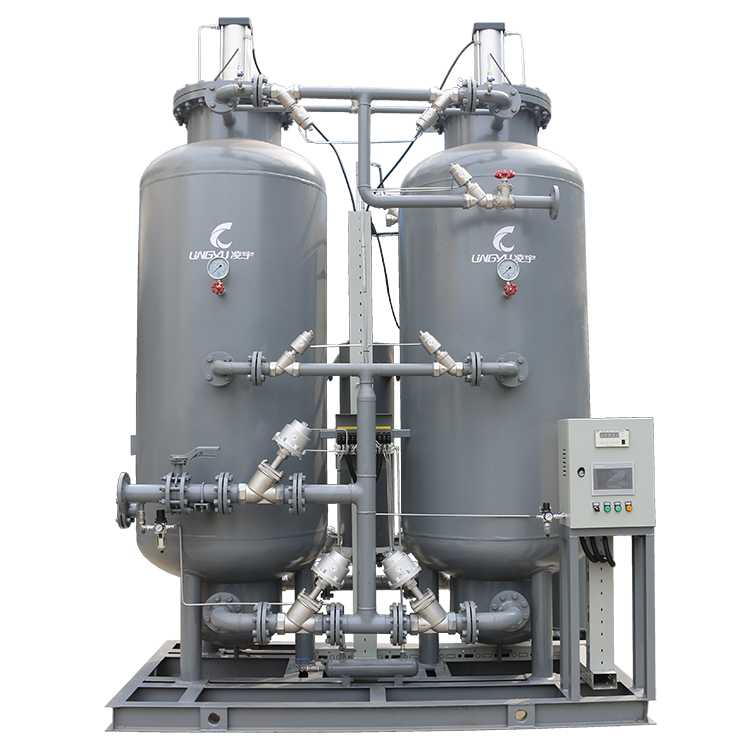
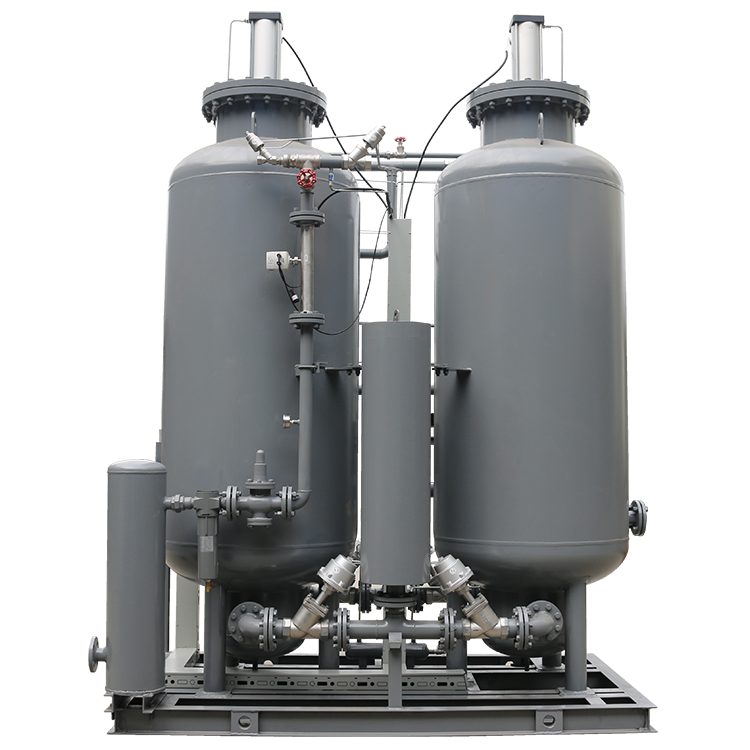
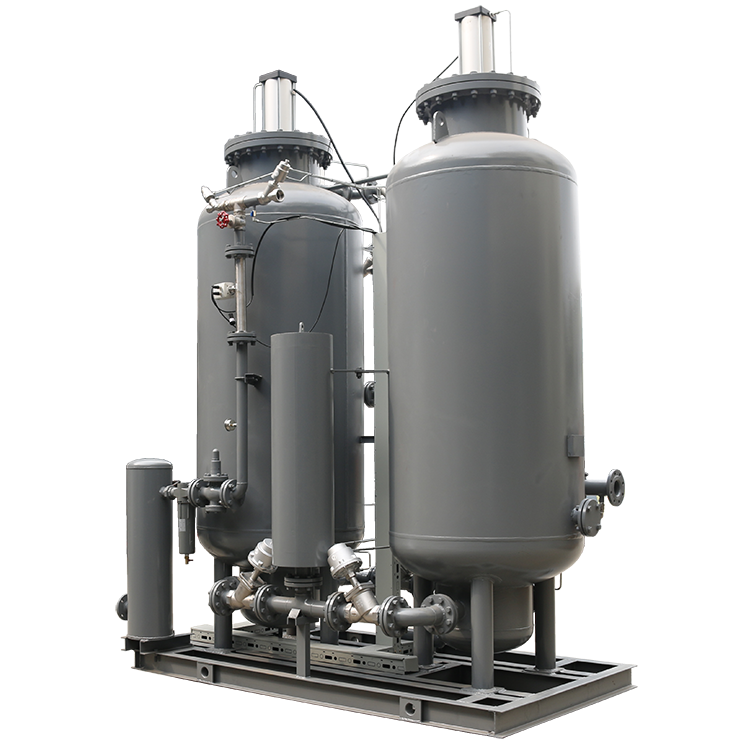
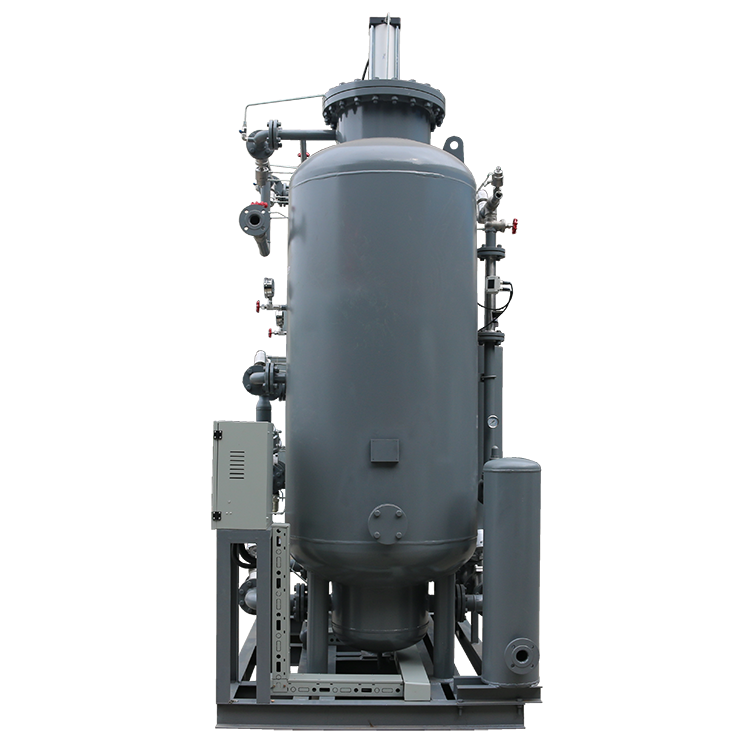
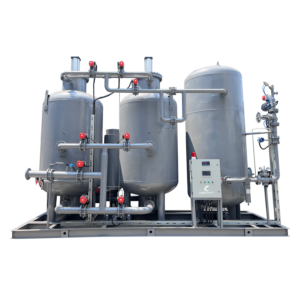
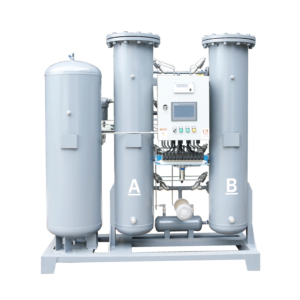
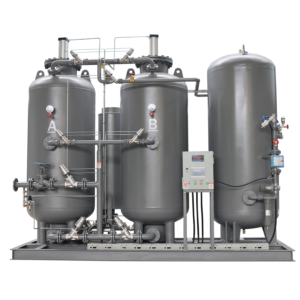
The PSA Nitrogen Generator uses Pressure Swing Adsorption (PSA) technology to separate nitrogen from compressed air and provide a stable on-site nitrogen supply. The system is equipped with two adsorption towers filled with high-performance carbon molecular sieve (CMS), which selectively adsorbs oxygen while allowing nitrogen to pass through as the product gas.
During operation, compressed air enters one tower, where oxygen molecules are captured by the CMS and nitrogen is collected at the outlet. At the same time, the second tower enters the regeneration stage, releasing the adsorbed oxygen into the atmosphere together with a small amount of nitrogen.
When the first tower reaches adsorption saturation, the system automatically switches. The regenerated tower begins nitrogen production, while the saturated tower starts regeneration. Controlled by a PLC automatic control system, the two towers work alternately in a continuous cycle, ensuring stable nitrogen purity, reliable performance, and uninterrupted nitrogen output.
To ensure stable nitrogen purity and efficient long-term operation, the PSA Nitrogen Generator should be used under the following recommended conditions:
- Inlet temperature: ≤ 40℃
- Inlet pressure: 0.5–0.8 MPa
- Nitrogen purity: 95%–99.999%
- Nitrogen dew point: ≤ -40℃
- Ambient temperature: ≤ 40℃
- Switching cycle: 45–60 seconds
- Voltage / frequency: 220V / 50Hz
- Noise level: ≤ 75 dB
For the best operating result, the generator should be supplied with clean and stable compressed air. Proper pre-treatment, including air filtration and drying, is recommended to protect the carbon molecular sieve, maintain nitrogen purity, and extend equipment service life.
Nitrogen Purity: 98%
| Nitrogen Production (m³/h) | Inlet Pipe Size | Outlet Pipe Size | Dimensions (H × L × W mm) | Effective Air Consumption (m³/min) |
|---|
| 20 | DN20 | DN15 | 1500 × 850 × 500 | 0.66 |
| 30 | DN20 | DN15 | 1800 × 900 × 600 | 1.00 |
| 50 | DN20 | DN20 | 1900 × 1000 × 600 | 1.67 |
| 70 | DN32 | DN25 | 2400 × 1150 × 700 | 2.33 |
| 80 | DN32 | DN25 | 2400 × 1150 × 700 | 2.66 |
| 100 | DN32 | DN32 | 2600 × 1150 × 800 | 3.33 |
| 120 | DN40 | DN32 | 2600 × 1200 × 800 | 4.00 |
| 140 | DN40 | DN32 | 2600 × 1400 × 900 | 4.66 |
| 160 | DN50 | DN40 | 2600 × 1500 × 900 | 5.33 |
| 180 | DN50 | DN40 | 2750 × 1600 × 900 | 6.00 |
| 200 | DN50 | DN40 | 2750 × 1750 × 900 | 6.67 |
| 250 | DN50 | DN50 | 2750 × 1900 × 1000 | 8.33 |
| 300 | DN65* | DN50 | 2650 × 2160 × 1280 | 10.00 |
| 350 | DN65 | DN50 | 2890 × 2200 × 1200 | 11.67 |
| 400 | DN65 | DN65 | 2890 × 2200 × 1200 | 13.33 |
| 450 | DN65 | DN65 | 2900 × 2500 × 1350 | 15.00 |
| 500 | DN80 | DN80 | 2900 × 2500 × 1350 | 16.67 |
| 550 | DN80 | DN80 | 2900 × 2500 × 1350 | 18.33 |
| 600 | DN80 | DN80 | 2900 × 2500 × 1400 | 20.00 |
Note: The above data is based on an adsorption pressure of 0.8 MPa (gauge pressure), an ambient temperature of 20℃, and 80% relative humidity. It is for reference only and may change without prior notice.
In the Philippines, where high humidity, warm ambient temperatures, and seasonal heavy rainfall can increase the risk of condensation in compressed air systems, the Shell Tube Refrigerated Air Dryer is especially suitable for industrial users that require stable moisture removal, reliable compressed air quality, and continuous-duty performance. With a stable outlet pressure dew point of 2°C to 10°C, an air-cooled design, and the ability to handle inlet temperatures up to 80°C, it is well suited for general-purpose compressed air treatment in demanding tropical operating conditions.
- Food and Beverage Processing
Suitable for non-product-contact compressed air uses in food and beverage plants, including packaging support, conveying systems, pneumatic controls, and utility air networks. In warm and humid factory environments, stable refrigerated drying helps reduce condensation risk and improve day-to-day equipment reliability. - Electronics and Electrical Manufacturing
Recommended for electronics assembly support systems, dry utility air, pneumatic tools, and moisture-sensitive production environments where stable compressed air quality helps reduce moisture-related interruptions and improve process consistency. - Laboratory Analyzers and Technical Rooms
Applicable to analytical equipment, laboratory air systems, and technical support environments where moisture control is important for reliable testing conditions and equipment stability. - Environmental Chambers and Test Systems
Suitable for test chambers and controlled environments where consistent air dryness supports accurate simulation and stable operating conditions. - Dry Sprinkler Systems and Building Utility Air
Recommended for dry sprinkler systems and related utility air applications where dry compressed air helps reduce internal corrosion and moisture buildup in pipelines. - Ozone Generators and Specialized Utility Systems
Can be used where dry compressed air helps improve operating stability and reduce moisture-related impact on equipment performance. - General Industrial Manufacturing
Suitable for pneumatic tools, automation systems, centralized compressed air networks, and production lines where dependable moisture control is required to protect downstream equipment and maintain stable operation. - CNC Machining and Automation Systems
Well suited for pneumatic components, automated machinery, and control systems where dry compressed air helps reduce wear, improve system stability, and support efficient operation. - Waveguide Drying and Communication-Related Systems
Applicable to technical systems where dry air is needed to reduce the risk of condensation and corrosion in sensitive air-supported equipment. - Coastal and High-Humidity Industrial Facilities
For factories located in coastal Philippine cities or other high-humidity areas, this dryer helps reduce the moisture burden on compressed air systems and supports more stable downstream operation under warm, moisture-laden ambient conditions.
Explore More Industry Applications